

The Critical Path is composed of those tasks whose finish dates affect the finish date of the overall project. In other words, if a critical task finishes late, the project will likely finish late also, unless you are able to adjust to the delay and make up time elsewhere. (Daley, 2011, p48).
A brief background to CPA
Critical Path Analysis (CPA) grew out of Network Analysis, which is a generic term for several planning methods that originated in the 1950s.Various ways of project planning were developed that enabled Project Managers to map and understand the relationships between tasks. These methods include precedence diagrams, network on arrow, PERT and others. They used different notation, but they enabled the planner to identify the Critical Path through a project.
The critical path networks improved on Gantt charts, because they provided more powerful notation enabling the capture of all logical interdependencies between different activities (Lock, 2007, p188).
Definition of the Critical Path
Many people misunderstand the term 'Critical Path' assuming that it refers to mission critical project tasks. The Critical Path is the series of tasks that must finish on time for the entire project to finish on schedule. Each task on the critical path is a time critical task. You can also think of it as:- the longest path from start to finish
- or the path without any slack,
- the path corresponding to the shortest time in which the project can be completed.
The The best way to understand the Critical path is to see an example. Below is a table showing the precedence of tasks for a simple CD/DVD publishing project

DVD Publishing project - Task list with predecessors
| Task | Predecessor | Duration (days) |
| 1. Project start | None | 0 |
| 2. Write contents | 1 | 20 |
| 3. Produce artwork | 1 | 10 |
| 4. Design menu | 3 | 5 |
| 5. Select distribution house | 1 | 5 |
| 6. Order CDs, cases and inlays | 5 | 1 |
| 7. Testing and Glass Master | 2,4,6 | 10 |
| 8. Duping and packaging | 7 | 8 |
| 9. Deliver | 8 | 3 |
Critical Path Example
Mapped out as a precedence diagram we can clearly see the project logic.

This is a simple diagram and you may well be able to spot the critical path already.
The critical path is Project start - Write contents - Testing and glass master - Duping and packaging - Deliver.You may also have noticed that some tasks could be delayed without impacting the critical path i.e. without impacting the end date of Duping and packaging. Most projects are much more complex and the Project Manager will need to follow a process to calculate the critical path and identify the slack in the project. Learn how to create a Precedence Diagram or Work Flow Diagram
Why is the Critical Path important?
Critical path is probably the most useful tools [sic] project management offers for managing resources in a dynamic environment. (Bender, 2009, p42).
Without this technique you will never be truly confident about shortening the duration of your projects or becoming efficient and effective with resources. (Harper-Smith and Derry, 2010, p.194)In Project Management: Fast Track to Success, Patrick Harper-Smith and Simon Derry explain that understanding the Critical Path can give you a major advantage as a Project Manager. It is only by calculating the Critical Path that the project manager can identify the means by which they can shorten the duration of the project. The only way to reduce the plan duration is to reduce the duration of a task or tasks on the critical path - for example, by adding resources. If the project manager doesn't know the critical path they could easily spend considerable time working to reduce the duration of tasks that will not impact the project end date.
Using Microsoft Project? This video shows how to view the Critical path in Microsoft Project.
References and further reading about the Critical Path
Derry, S. and Harper-Smith, P. (2010) Project Management: Fast Track to Success: The low down on the top job. Financial Times/ Prentice Hall, p.193 - 194.B. Bender, M. (2009) A Manager's Guide to Project Management: Learn How to Apply Best Practices. FT Press, p.42.
S. Daley. (2011) Microsoft Project 2010 in Depth. Pearson Education, Inc. p.48.
Lock, D. (2007) Project Management by Dennis Lock 9 Rev edition (2007). 9th ed. Aldershot: Gower, p.188. Latest edition Project Management
Download example of a Critical Path Analysis
Visio download Critical Path Analysis .vsdx
PDF download - Download the Critical Path Analysis .pdf
Don't have Visio? Use Lucidchart
You can import this flowchart to Lucidchart for Free! Follow these simple steps:- Download the Visio file of the Critical Path Example.
- Sign-up for a free Lucidchart account
- On the "My Documents" page, click the "Import" dialogue box and select "Import Visio."
- Select the file or drag and drop and click "Import."
- Click "View Document" to see your flowchart
Why you need Lucidchart for Flowcharts!
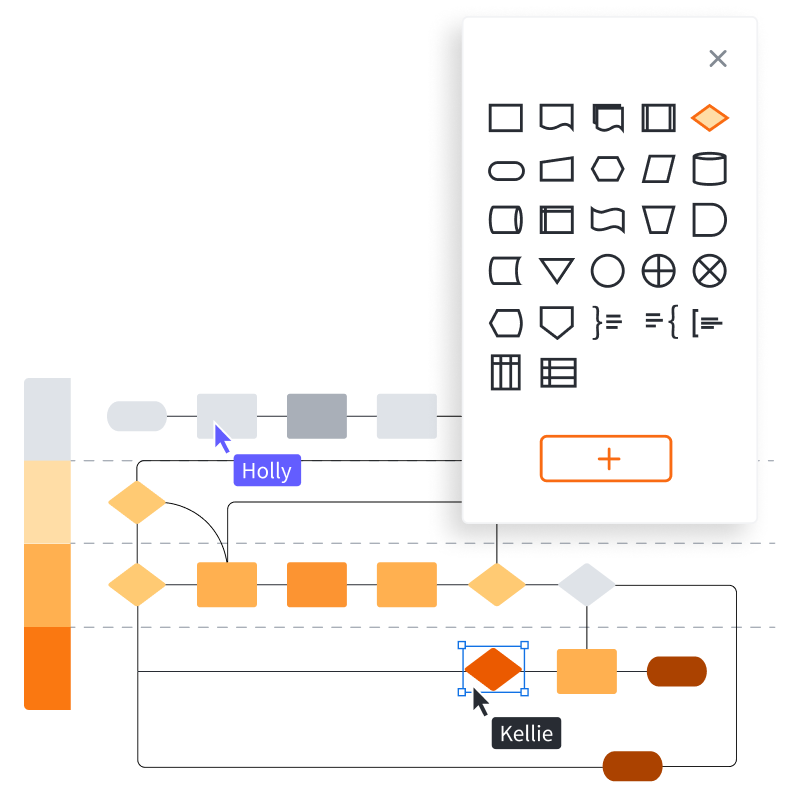
- Easy to use with a simple drag and drop GUI
- Great pricing! Unlimited digrams for as low as $7.95 / month
- 100s of templates for Flowcharts, UI design, Projects, and Reports
- FREE online training videos, webinars and case studies
- Multiple people can work on a diagram at once
- Share with your team with a click of a button
Read more guides on using Project Management and Microsoft Project
- Project Calendars - Non-working time - enter UK holidays into Microsoft Project calendars
- Constraints part 1 - How to use Microsoft Project constraints
- Constraints part 2 - Common mistakes in using constraints
- Create constraints - How to create project constraints
- Critical Path - Viewing the Critical Path - video tutorial
- Filters - How to filter your plan by certain tasks or resources
- Filters - How to create a custom filter in Microsoft Project
- Highlight tasks - This step by step guide shows how to highlight particular tasks in Microsoft Project.
- Hyperlinks - How to create hyperlinks in Microsoft Project
- Outlook tasks - How to import Outlook tasks into Microsoft Project
- How to create a PDF of your project plan - Microsoft Project 2010 to pdf
- Scheduling problems - How to resolve a common scheduling problems in Microsoft Project