

Put your strengths, weaknesses, opportunities and threats on one page. Download our free Excel SWOT template, add your points and use the results to agree what to do next.
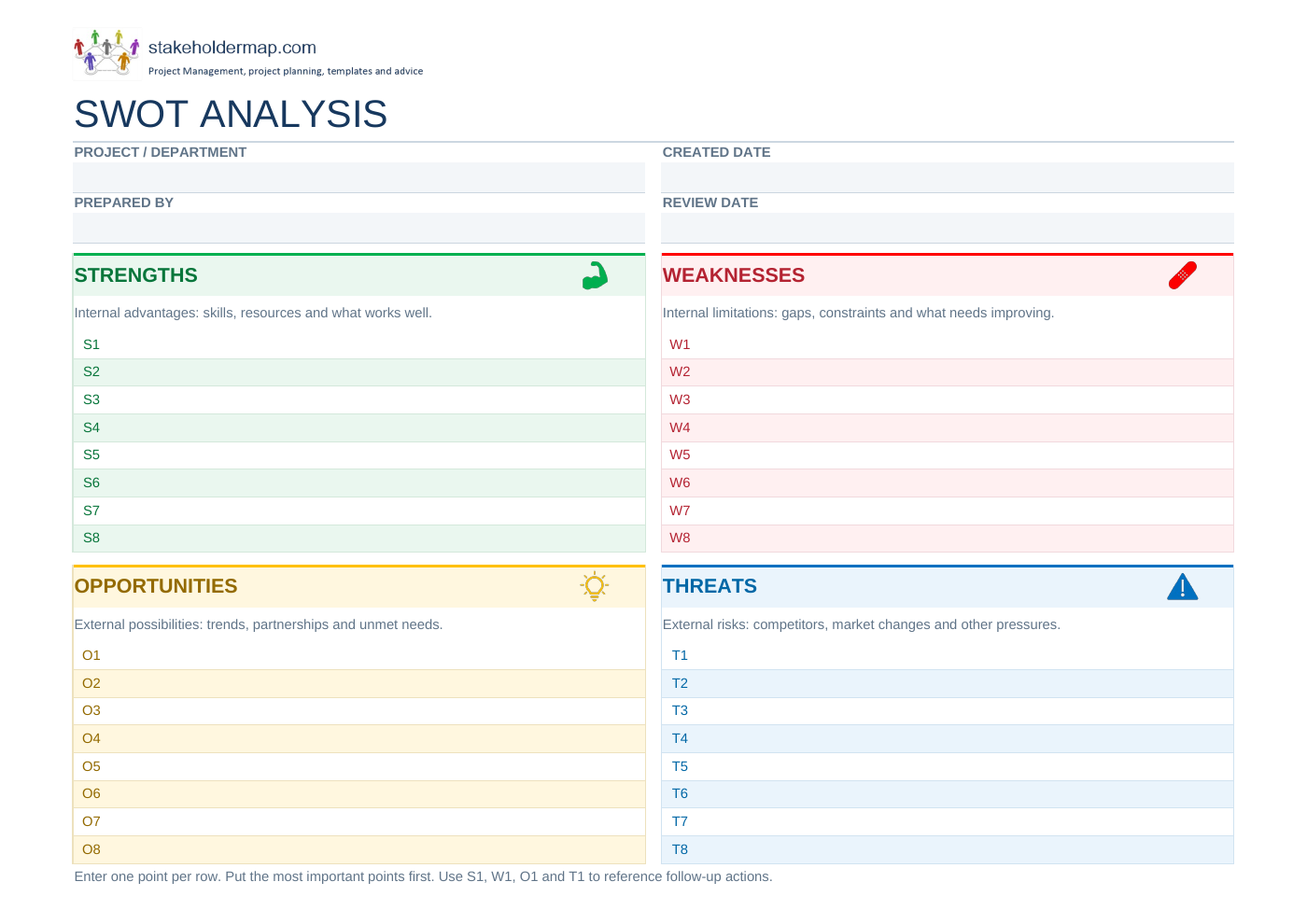
The four coloured sections keep your analysis easy to scan. The updated workbook adds clearer writing space, numbered entries and separate fields for your project, name and dates.
Download the free Excel SWOT template
Includes the blank SWOT matrix, instructions and useful resources. The matrix is set up to print on one A4 landscape page.
Download SWOT template (.xlsx)Editable Excel workbook. Eight writing rows in each section.
Original versions in other formats
These retain the original layout: Excel 97-2003 (.xls) and OpenDocument (.ods). Choose the .xlsx download above for the updated design.
Preview and workbook contents
| Worksheet | What you get |
|---|---|
| SWOT | A four-box matrix with prompts, eight rows per section, entry references and project details. |
| INSTRUCTIONS | Steps for completing the analysis, discussion prompts and help with editing and printing. |
| Useful resources | Links to more business, project and stakeholder management templates. |
Strengths and weaknesses sit on the top row. Opportunities and threats sit below. The original icons and green, red, amber and blue colours remain, with lighter borders and shaded writing rows.
How to complete your SWOT analysis
SWOT stands for Strengths, Weaknesses, Opportunities and Threats. Use it to assess a project, department, business or personal goal before making a decision.
- Set the scope. Name the project or department and the decision you want to inform. Add your name, the created date and a review date.
- Look inside and outside. Strengths and weaknesses are internal, such as skills, capacity and processes. Opportunities and threats come from outside, such as customer demand, competitors and supplier changes.
- Write one specific point per row. Add evidence where you have it. “Two trained staff can cover each role” tells you more than “good team”.
- Put the most important points first. Leave spare rows blank. You do not need eight points in every box.
- Agree the next steps. Use references such as S1 and T2 when recording actions, owners and due dates in your action plan. Return to the analysis on the review date.
SWOT example: launching an online shop
This fictional example considers whether a small retailer should add online ordering and local delivery. Each point relates to that decision.
Strengths
Internal advantages: what can you build on?
- S1 A loyal local customer base gives the shop a group to invite to a trial.
- S2 Staff know the products well and can answer detailed customer questions.
Weaknesses
Internal limitations: what needs improving?
- W1 Stock records are updated manually, so online availability could be wrong.
- W2 The team has no experience packing and dispatching online orders.
Opportunities
External possibilities: where could you benefit?
- O1 Customers have asked for local delivery because they cannot always visit.
- O2 A local courier offers delivery slots suitable for a small trial.
Threats
External risks: what could undermine the plan?
- T1 The courier plans a price review that could reduce the profit on each order.
- T2 A national competitor already offers free delivery above a minimum spend.
Turn your analysis into actions
Four filled boxes are the start. Decide which findings change your plan, then give each action an owner and a due date. For the online shop example:
- S1 + O1: Invite existing customers to a small delivery trial and collect their feedback.
- W1: Check how the online shop will keep stock availability accurate before accepting orders.
- T1: Get the courier’s proposed rates and calculate the margin after delivery costs.
To explore combinations across all four sections, use our TOWS analysis guide and Excel template.
Editing and printing questions
How do I print just the SWOT matrix?
Select the SWOT worksheet, then choose File > Print > Print Active Sheets. The template uses A4 landscape and fits the matrix on one page. Check Print Preview after adding your text.
Can I add more writing space?
Text wraps in the writing cells. Increase the row height if a point is cut off. To add entries, insert a whole row within a section, copy the neighbouring row’s formatting and update the references. This adds a row to both sides of the matrix. Check the print area afterwards.
Can I save the analysis as a PDF?
Yes. Select the SWOT worksheet and use Excel’s PDF export or Save As option. Choose the active sheet in the export options. If extra rows make the text too small, allow more than one page.
Does the workbook include the example above?
The workbook contains a blank matrix for your own analysis. The online shop example is on this page, so you can refer to it while completing your template.
More SWOT and TOWS templates
Choose another layout or take your findings into a TOWS analysis.

