

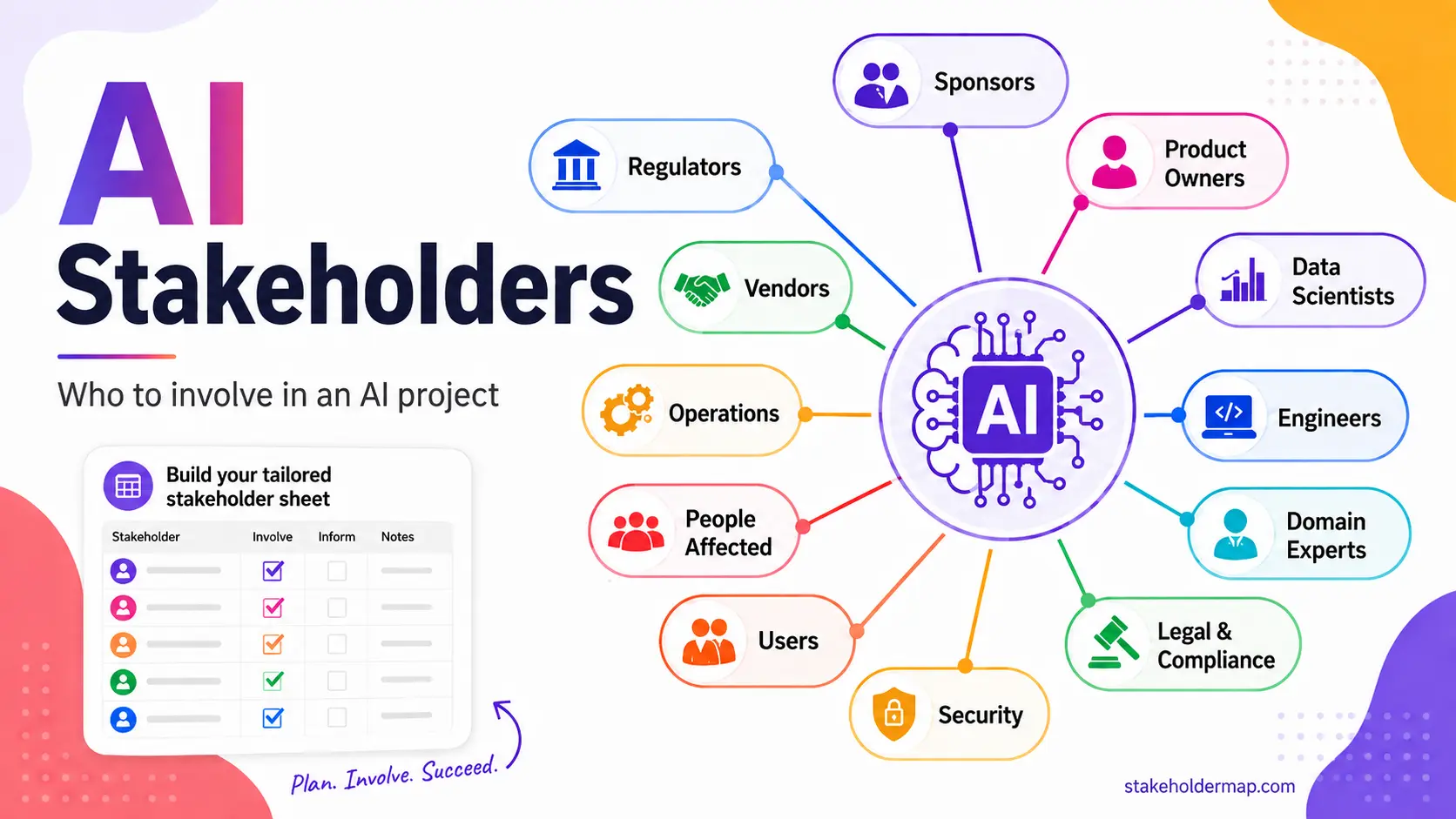
AI stakeholders are the people, groups and organisations that can influence an artificial intelligence system, contribute to it, use it, govern it, or be affected by its outputs and decisions.
An AI project usually involves more stakeholders than the team building the technology. The system may depend on data collected by other teams, models supplied by external companies, people who review or act on AI outputs, and people who may never use the system but are still affected by what it recommends or decides.
Table of Contents:
- AI stakeholder list
- 1. Decide: business and product stakeholders
- 2. Data: people who provide and manage AI data
- 3. Design and build: AI and technical teams
- 4. Test and assure: people who challenge the AI
- 5. Use: people who use AI outputs
- 6. People affected by AI
- 7. Run and monitor: people who operate the AI
- 8. Govern: risk, legal, ethics and compliance
- External AI suppliers and dependencies
- Example AI stakeholder list
- AI stakeholders that are often missed
- How to identify AI stakeholders
- Quick AI stakeholder checklist
- What to do next
AI stakeholder list
Use this list as a prompt rather than a fixed project structure. A small internal AI assistant may involve only a few of these stakeholders. An AI system used for recruitment, healthcare, finance, education or public services could involve many more.
Create your own AI stakeholder list
Tick the stakeholders that apply to your AI project. You can select them all, clear the list, download your selection as an Excel workbook, or copy it ready to paste into Google Sheets.
The Excel file is created on your device. The spreadsheet library is loaded only when you click Download Excel, so it does not add to the initial page load. The workbook also contains a Resources worksheet with useful StakeholderMap.com links.
Decide
- Executive sponsor
- Business owner
- AI product owner
- Product manager
- Project or programme manager
- Business analyst
- Process owners
- Subject matter experts
- Finance or budget owner
Data
- Data owners
- Data stewards
- Data engineers
- Data architects
- Database administrators
- Data quality specialists
- People who collect or create source data
- People represented in training data
- Data providers
Design and build
- AI or ML product designers
- UX designers
- User researchers
- AI architects
- Solution architects
- Data scientists
- Machine learning engineers
- AI engineers
- Software developers
- Prompt or conversation designers
- Integration developers
- Technical leads
Test and assure
- Test and QA teams
- Model evaluation specialists
- AI red teams
- Cybersecurity testers
- Bias and fairness reviewers
- Accessibility specialists
- Domain experts validating outputs
- User acceptance testers
- Independent assurance or audit teams
Use and affected
- Primary AI users
- Occasional users
- Managers using AI-generated reports
- Employees working alongside AI
- Customers
- Members of the public
- People subject to AI-supported decisions
- People whose work changes because of AI
- People whose data is used by the AI
- Employee representatives or trade unions
Run and govern
- MLOps engineers
- DevOps or platform teams
- Application support
- Service desk
- Model monitoring teams
- Cybersecurity team
- Data protection officer or privacy team
- Legal team
- Compliance team
- Risk management
- Internal audit
- AI ethics or responsible AI group
- Senior governance or AI steering committee
- Regulators
The quick list gives you a starting point. The sections below explain why each group matters and help you find stakeholders who are easy to overlook.
1. Decide: business and product stakeholders
These stakeholders decide why AI is being used, what outcome it should improve, what decisions it may influence and what level of risk the organisation is prepared to accept.
Executive sponsor
The executive sponsor provides authority, funding and senior support. For higher-risk AI, the sponsor may also need to make sure there is clear accountability for how the system is used.
Business owner
The business owner owns the process or outcome the AI is intended to improve. They should be able to explain the problem before the team decides that AI is the right solution.
AI product owner and product manager
Product roles turn the business need into priorities for the AI team. They help define what the system should do, who it is for, how success will be measured and what behaviour is unacceptable.
Project or programme manager
The project or programme manager coordinates the people, dependencies, risks, decisions and change required to deliver the AI capability.
Business analysts and process owners
These stakeholders explain how work happens now and where the AI will fit. They can identify points where an AI recommendation, prediction or automated action changes an existing process.
Subject matter experts
AI outputs need to make sense in the real domain. Clinicians, lecturers, accountants, engineers, customer-service teams or other specialists may be needed to define requirements and judge whether outputs are useful and safe.
2. Data: people who provide and manage AI data
Data stakeholders are particularly important in AI because the behaviour of the system may depend heavily on the information used to train, fine-tune, retrieve for or evaluate it.
Data owners
Data owners are accountable for important datasets. They may decide whether the project can use the data and under what conditions.
Data stewards and data quality specialists
These stakeholders understand how data is defined, collected, maintained and checked. They can identify missing, inconsistent, outdated or misleading data before it becomes an AI problem.
Data engineers and data architects
Data engineers build the pipelines that move and prepare data. Data architects help define how information is structured, connected and governed across systems.
People who collect or create source data
A dataset may look like a technical asset, but it often comes from human activity. Staff entering case notes, customers filling in forms, researchers labelling examples or operational teams recording outcomes can all affect the quality of AI inputs.
People represented in the data
People whose behaviour, records, writing, images or other information appears in the data can be stakeholders even when they never interact with the finished AI system.
3. Design and build: AI and technical teams
These stakeholders turn the proposed use case into a working AI system and connect it to the organisation's existing technology and processes.
Data scientists
Data scientists explore data, develop models, compare approaches and evaluate how well a model performs against the intended task.
Machine learning engineers
Machine learning engineers turn models into reliable systems that can be deployed, scaled, monitored and maintained.
AI engineers
AI engineers may build applications around foundation models or other AI services, design prompts and workflows, connect models to organisational data and add controls around model outputs.
AI and solution architects
Architects decide how the AI capability fits with other systems, data sources, security controls, platforms and suppliers.
Software developers and integration developers
Most AI projects still require conventional software. Developers create the interfaces, workflows, APIs and integrations through which people and systems use the AI.
UX, user research and conversation design
AI systems can fail because people misunderstand what the system can do, place too much trust in an answer, or cannot tell when human review is needed. Designers and researchers help make the interaction understandable and usable.
4. Test and assure: people who challenge the AI
AI testing needs to go beyond checking whether the software runs. The project may also need to test whether outputs are accurate enough for the use case, whether the system behaves consistently, and how it responds to unusual or adversarial inputs.
Test and QA teams
Test teams check the application around the AI as well as the workflows, integrations, permissions and expected behaviour.
Model evaluation specialists
Evaluation specialists define test cases and measures for the model itself. They may compare model versions and look for unacceptable failure patterns.
AI red teams
Red teams deliberately challenge an AI system to discover unsafe, misleading, insecure or easily manipulated behaviour before it causes problems in real use.
Bias and fairness reviewers
Where AI affects people, reviewers may need to examine whether outcomes differ unfairly between groups or whether the underlying data creates systematic disadvantages.
Domain experts
Subject matter experts are often needed again during testing. A technically plausible answer may still be wrong or unsafe in the real domain.
User acceptance testers
Real users should test whether the AI helps them complete the work safely and effectively, including what happens when the AI is uncertain or wrong.
5. Use: people who use AI outputs
AI users may interact directly with a chatbot, recommendation system or prediction tool, or they may simply receive an AI-generated score, summary, alert or report inside another system.
Primary and occasional users
Frequent users understand the everyday strengths and weaknesses of the system. Occasional users may need clearer guidance because they have less opportunity to learn its limitations.
Managers and decision-makers
Managers may use AI-generated dashboards, forecasts, risk scores or recommendations. Their interpretation of the output can be as important as the model itself.
Employees working alongside AI
AI may change how people research, write, assess, plan, diagnose, approve, prioritise or communicate. Those employees need to be treated as stakeholders in the change, not simply as end users of a new tool.
Do not identify only the people who operate the AI
One of the most important AI stakeholder questions is: who experiences the consequences of the AI output? They may be different from the person using the system.
6. People affected by AI
Some of the most important AI stakeholders may never see the system. They are affected because somebody else uses an AI prediction, classification, recommendation or generated output when making a decision about them.
Possible stakeholders include:
- job applicants assessed with AI support;
- customers receiving AI-generated decisions or recommendations;
- students affected by AI-supported assessment or support decisions;
- patients affected by AI-supported clinical decisions;
- employees whose performance or work is assessed using AI;
- people whose access to services is influenced by an AI score;
- people whose data is used to train or operate the system;
- people whose jobs or responsibilities change because of automation;
- employee representatives or trade unions; and
- communities that may experience wider effects from the system.
Who could be helped, disadvantaged, excluded or treated differently because this AI system exists?
7. Run and monitor: people who operate the AI
AI systems can change after launch because data changes, suppliers update models, user behaviour changes or the system encounters situations that were not present during testing.
MLOps engineers
MLOps engineers manage deployment, model versions, pipelines, monitoring and the operational processes needed to keep machine-learning systems reliable.
DevOps, platform and cloud teams
These teams provide the infrastructure, environments, access controls and shared services on which the AI application depends.
Model monitoring teams
Monitoring may look for changes in performance, data, costs, response quality, misuse, unexpected outputs or other signals that the AI needs attention.
Application support and service desk
Support teams deal with incidents and user problems. They need a route for escalating AI-specific failures rather than treating every issue as an ordinary software fault.
Human reviewers and escalation teams
Some AI processes need a person who can review an output, override it, investigate uncertainty or handle cases that should not be left to automation.
- human reviewers;
- exception-handling teams;
- incident response teams;
- model owners;
- service owners; and
- business continuity teams.
8. Govern: risk, legal, ethics and compliance stakeholders
Governance stakeholders help decide whether the proposed AI use is acceptable, what controls are required and who is accountable when something goes wrong.
Cybersecurity team
Cybersecurity stakeholders review threats to models, data, prompts, interfaces, identities and connected systems.
Data Protection Officer and privacy team
Where personal data is involved, privacy specialists may need to review what data is used, why it is needed, how long it is kept and how people's rights are protected.
Legal team
The legal team may advise on issues such as:
- contracts;
- intellectual property;
- licensing;
- use of personal or confidential information;
- responsibility for AI-generated content; and
- legal duties that apply to the use case.
Risk management and internal audit
Risk and audit teams can challenge assumptions, review controls, test accountability and consider what happens if the AI behaves unexpectedly or the supplier becomes unavailable.
AI ethics or responsible AI group
Some organisations have a responsible AI committee, ethics group or AI governance board that reviews higher-risk uses and sets organisation-wide principles or controls.
Senior governance and regulators
Boards, steering committees and regulators may become important stakeholders where an AI system has significant effects on customers, employees, patients, students, citizens or regulated decisions.
External AI suppliers and dependencies
Many AI systems depend on technology, models and data supplied by other organisations. Those suppliers should appear on the stakeholder map because changes to their services can directly change the project's risk, cost and behaviour.
- foundation model providers;
- AI platform providers;
- cloud providers;
- model hosting providers;
- vector database or retrieval service providers;
- external data providers;
- data labelling suppliers;
- AI consultants;
- software vendors embedding AI features;
- cybersecurity suppliers;
- specialist assurance providers;
- research partners;
- open-source model and software communities;
- professional advisers; and
- regulators and standards bodies.
Example: stakeholders for an AI customer-service assistant
Imagine an organisation introduces a generative AI assistant to help customer-service staff answer questions. The assistant retrieves information from internal guidance and drafts responses for staff to review before they are sent.
| Group | Example stakeholders |
|---|---|
| Decide | Executive sponsor, Head of Customer Services, product owner, project manager, process owner |
| Data | Owners of customer-service guidance, knowledge-management team, data owners, privacy team |
| Design and build | AI engineers, software developers, UX designer, solution architect, integration developers |
| Test and assure | Customer-service subject matter experts, QA, security testers, model evaluators, user acceptance testers |
| Use | Customer-service advisers, supervisors, team managers |
| Affected | Customers receiving responses drafted with AI, including customers with accessibility or language needs |
| Run | Application support, MLOps or platform team, service desk, incident response, knowledge owners |
| Govern | Cybersecurity, privacy, legal, risk, responsible AI governance |
| External | Foundation model provider, cloud provider and any external knowledge or software suppliers |
Notice that the customer is a stakeholder even though the employee, not the customer, operates the AI tool. The customer experiences the result.
AI stakeholders that are often missed
The technical team and sponsor usually make the first stakeholder list. Before you finish, check specifically for:
- people represented in training, evaluation or operational data;
- people affected by an AI-assisted decision who never use the AI;
- people responsible for collecting the source data;
- data owners and data stewards;
- human reviewers and escalation teams;
- people who need to challenge or override an AI output;
- staff whose jobs or processes will change;
- employee representatives or trade unions;
- accessibility specialists;
- model monitoring and operational support teams;
- owners of systems connected to the AI;
- foundation model and external AI providers;
- privacy, legal, risk and internal audit teams;
- responsible AI or ethics governance;
- customers or members of the public who may be affected; and
- regulators where the AI is used in a regulated activity.
How to identify AI stakeholders
Work through the AI lifecycle and the consequences of the system rather than trying to remember stakeholder job titles from a blank page.
Why are we using AI?
- Who asked for the AI capability?
- Who owns the problem it is meant to solve?
- Who is paying for it?
- Who decides whether it has succeeded?
- Who decides what the AI is allowed to do?
What data does it depend on?
- Who owns the data?
- Who collects, creates or maintains it?
- Who understands its weaknesses?
- Whose information is represented in it?
- Who approves its use?
Who will design and build it?
- Who chooses the model or AI service?
- Who builds prompts, agents, workflows or models?
- Who designs the user experience?
- Who integrates the AI with existing systems?
- Who owns the technical architecture?
Who will test and challenge it?
- Who knows what a good answer or prediction looks like?
- Who tests unusual and high-risk cases?
- Who looks for security weaknesses?
- Who tests accessibility?
- Who looks for unfair or systematically poor outcomes?
Who will use the output?
- Who types prompts or supplies inputs?
- Who reads AI-generated outputs?
- Who acts on AI recommendations?
- Who is expected to review or override the AI?
Who will be affected?
- Who could gain or lose something because of the AI output?
- Who may be classified, prioritised, recommended, rejected or investigated?
- Whose work changes?
- Whose data is used?
- Who might find it difficult to challenge an AI-supported decision?
Who will run and monitor it?
- Who deploys it?
- Who monitors quality and performance?
- Who investigates incidents?
- Who supports users?
- Who decides when the model or system needs to be changed or withdrawn?
Who governs it?
- Who is accountable for the use of AI?
- Who is responsible for privacy and security?
- Who checks legal and compliance requirements?
- Who reviews ethical or responsible-AI concerns?
- Does a regulator or standards body have an interest?
Quick AI stakeholder checklist
Use this shorter list as a final check before completing your stakeholder identification.
- Executive sponsor
- Business owner
- AI product owner
- Project or programme manager
- Business analyst
- Process owners
- Subject matter experts
- Data owners
- Data stewards
- Data engineers
- Data scientists
- Machine learning engineers
- AI engineers
- AI and solution architects
- Software and integration developers
- UX designers and user researchers
- Test and QA teams
- Model evaluators and AI red teams
- Primary AI users
- Managers using AI outputs
- People subject to AI-supported decisions
- People whose data is used
- People whose work changes because of AI
- Human reviewers and escalation teams
- MLOps, DevOps and platform teams
- Application support and service desk
- Cybersecurity
- Data protection and privacy
- Legal and compliance
- Risk management and internal audit
- Responsible AI or ethics governance
- Foundation model providers
- Cloud and AI platform providers
- External data providers
- Regulators
What to do next
Identifying AI stakeholders is only the first step. Once you have your list, you can:
- add them to a stakeholder register;
- carry out a stakeholder analysis;
- assess their influence, interest, needs and concerns;
- create a stakeholder map;
- identify people who are highly affected even if they have little formal power; and
- plan how you will engage your stakeholders.
For closely related checklists, see the software development stakeholder list, Big Data stakeholder list and the 105 stakeholder checklist. You can also browse all sector and project-specific pages in the Stakeholder Lists hub.
Summary
A complete AI stakeholder list needs to go beyond the sponsor, data scientists and users. It should include the people who decide, provide data, design, build, test, use, operate and govern the AI, plus people who may be affected by its outputs without ever using the system themselves.
Use the selectable checklist on this page to create a tailored list for your own project, then use stakeholder analysis to decide who needs the closest attention and engagement.