

Stakeholder mapping helps you identify the people, groups and organisations that can influence your project or will be affected by it. You then assess what matters to them, how much influence they have and how you should work with them.
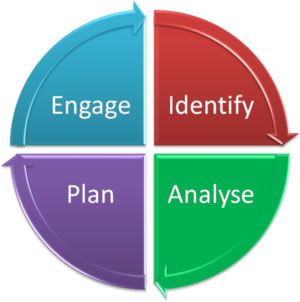
This guide shows you how to map stakeholders in four steps: identify them, analyse them, plan how to work with them and put your plan into action. You will also find worked examples, mapping methods and downloadable templates.
Stakeholder mapping shows you who can influence your project and who the project will affect. It helps the team spot risks, understand relationships and build support.
Whether you are running a large programme or a small change initiative, stakeholder mapping helps you answer three critical questions: Who matters most? What do they care about? How should we engage with them?
Stakeholder mapping versus stakeholder analysis
Stakeholder mapping is the broader process of identifying, analysing, planning for and engaging stakeholders. Stakeholder analysis is one stage within that process: it examines characteristics such as power, interest, influence, attitude, impact and urgency.
Use this stakeholder mapping guide for the complete process. When you are ready to assess and prioritise individual people or groups, use the detailed stakeholder analysis guide.
Why stakeholder mapping matters
Stakeholder mapping helps a project team decide where to focus its attention, anticipate support or resistance, and tailor communication to different needs. It also reduces dependence on informal knowledge held by individual team members.
Poor stakeholder engagement is a project risk
Project teams usually log and review schedule, cost and technical risks. They often overlook stakeholder risks.
Poor engagement can cause opposition, delay decisions and lead to expensive changes later in the project. At Casement Park , weak early engagement with local residents was followed by a judicial review, a complete redesign, significant delays and development costs that more than doubled.
Ignoring stakeholders does not make them neutral. Our stakeholder management case studies show how failing to understand people's concerns, build relationships and involve the right people can delay decisions, increase resistance and put projects at risk. Map stakeholders early so you can spot problems, build support and act before they become harder to solve.
Stakeholder mapping and stakeholder engagement support effective project delivery. “Effectively engage with stakeholders” is one of the 12 principles in the seventh edition of the Project Management Body of Knowledge (PMBOK Guide) .
Identifying, analyzing, and proactively engaging with stakeholders from the start to the end of the project helps to enable success.
Why a structured process works
Many teams believe they already know their stakeholders. In reality, this knowledge is often incomplete and held by individuals rather than shared across the project team.
A structured process creates a shared understanding of:
- Who has influence and decision-making power.
- Who will be affected by the project or change.
- Where resistance or conflicting interests may emerge.
- Who can support decisions and implementation.
- How engagement should change during the project.
See the stakeholder management case studies for examples of what can happen when important interests and relationships are missed.
Stakeholder mapping in four steps
The four steps form a continuous cycle. Stakeholders change, projects evolve and engagement must adapt. Review the map at key decision points and whenever the project environment changes.
1. Identify your stakeholders
Make a first list of everyone who can influence the project or will be affected by it.
List everyone first. Prioritise them later.
2. Analyse and prioritise stakeholders
Assess their power, interest, influence, impact, attitude, urgency and legitimacy. Choose the factors that will help you make a decision.
Your analysis will show who needs close attention, regular consultation, reassurance or support.
3. Plan communication and engagement
Decide what each priority stakeholder needs to know and what you need from them. Name the person who will manage the relationship. Choose the best communication channel and agree how often to use it.
Good communication does not mean sending more messages. Give the right people the right information at the right time and in the right format.
4. Engage and review
Follow the plan. Listen to stakeholders, ask for their views, answer their concerns and manage expectations. Record important decisions and update the map when their influence, interests or attitudes change.
Which stakeholder mapping method should you use?
Different methods answer different questions. Choose the method that will help you make a decision.
| Method | Best used for | Detailed guide |
|---|---|---|
| Power and interest matrix | Prioritising attention and engagement effort | Stakeholder analysis |
| Stakeholder matrices | Comparing power, interest, influence, impact or attitude | Stakeholder matrix examples |
| Stakeholder salience model | Assessing power, legitimacy and urgency | Stakeholder salience |
| Attitude mapping | Understanding support, opposition and likely behaviour | Stakeholder attitude mapping |
| Stakeholder mind map | Identifying stakeholder groups and relationships | Stakeholder mind map |
A simple stakeholder mapping example
Imagine a project implementing a new customer relationship management system. The sales director has high influence because they control sales-process decisions and high interest because the system affects their team directly.
The project team might therefore:
- Involve the sales director in requirements decisions.
- Agree the measures of success for the sales team.
- Provide regular progress and risk updates.
- Consult them before changing sales processes.
- Ask them to sponsor adoption within the department.
This example shows the complete sequence: identify the stakeholder, analyse their position, plan the relationship and carry out the engagement.
See a more detailed stakeholder analysis example .
Stakeholder mapping templates and tools
Use these guides and templates to create your stakeholder register, stakeholder map and engagement plan.
Stakeholder management templates
Find stakeholder maps, registers, worked examples, communication plans and engagement plans.
Stakeholder matrix examples
Compare the main stakeholder matrices and choose the dimensions that best support your decision.
Stakeholder salience
Learn how to assess stakeholders using power, legitimacy and urgency.
Stakeholder engagement guides
Plan communication, consultation and involvement for different stakeholder groups.
Choose your next stakeholder mapping guide
- What is a stakeholder?
- How to conduct stakeholder analysis
- Stakeholder matrix methods and examples
- What stakeholder engagement means
- How to plan stakeholder communication
- Principles of stakeholder management
Other popular project management resources
- 20 common project risks and example risk register
- Free project management templates
- Work breakdown structure examples
References
Project Management Institute. (2021). A guide to the Project Management Body of Knowledge (PMBOK Guide) (7th ed.). Project Management Institute.