

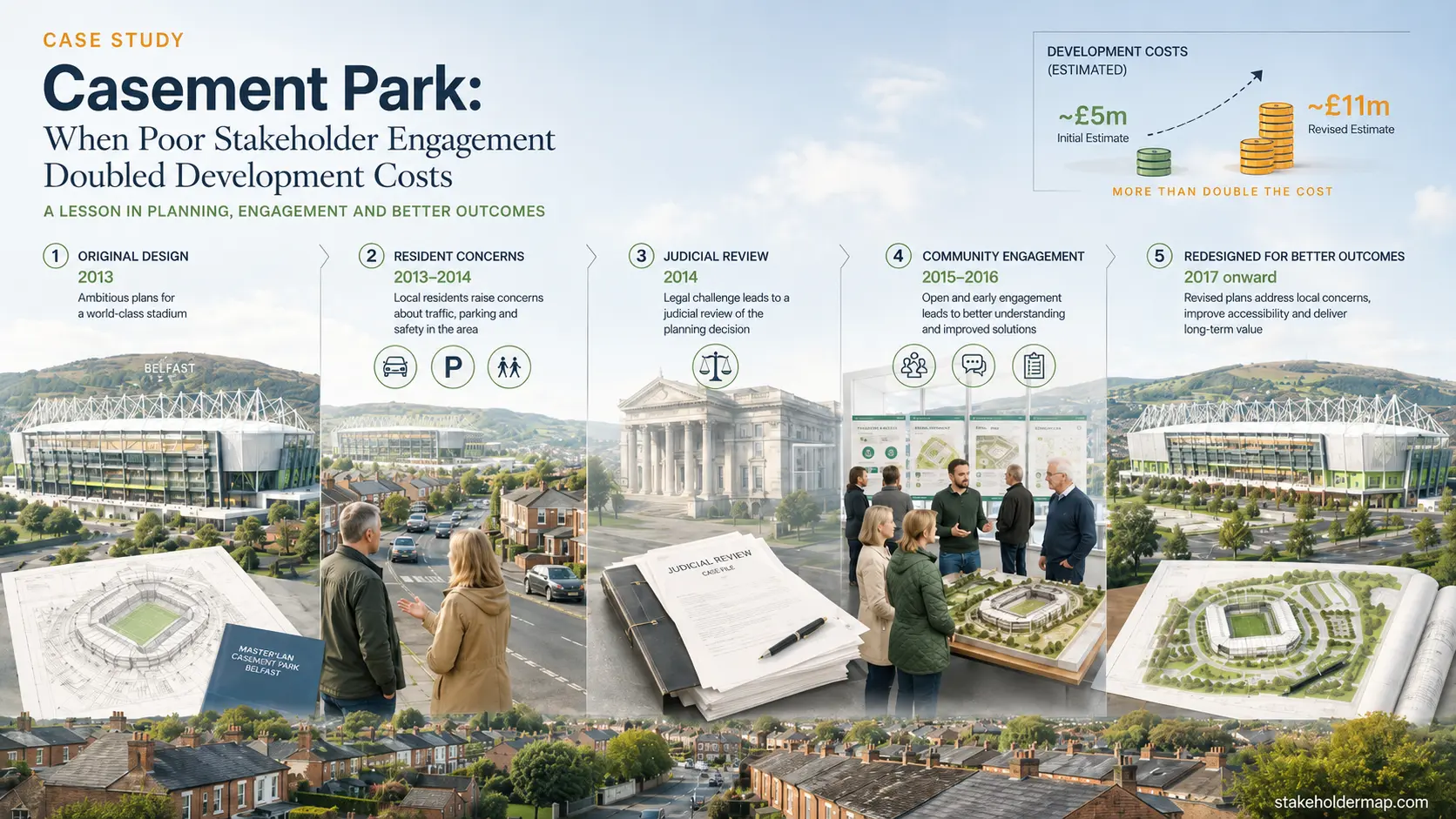
The Casement Park redevelopment is a stark example of the cost of engaging important stakeholders too late. Local residents felt that their concerns had not been heard. Planning permission was challenged in court and quashed. The project then went through a 32-week community engagement exercise and a complete redesign.
The Northern Ireland Assembly Public Accounts Committee found that development costs were likely to rise from about £5 million to £11 million. It linked the increase to having to design the project twice.
Casement Park case study summary
| Project | Redevelopment of Casement Park |
|---|---|
| Location | Andersonstown Road, Belfast |
| Original proposal | A new 38,000-seat stadium with facilities for matches, concerts, conferences, food and drink, community use and parking |
| Main stakeholder problem | Many local residents believed that early engagement was inadequate. The Department later accepted that it had underestimated resistance to the project. |
| Result | Judicial review, planning permission quashed, a 32-week community engagement exercise, complete redesign and significant delay |
| Development cost impact | Costs rose from an initial estimate of about £5 million to a likely £11 million |
The £5 million and £11 million figures refer to development costs. They are not the full cost of building the stadium.
What was planned?
The Gaelic Athletic Association planned to redevelop Casement Park as a 38,000-seat stadium. The scheme included more than match-day facilities. It also covered concerts, conferences, bars, restaurants, community facilities and parking.
A project of this size would affect far more people than those who planned to attend events. Nearby residents would also have to deal with crowds, traffic, parking, noise and changes to their local area.
This made residents a key stakeholder group . They had a strong interest in the project and enough power to challenge the planning decision.
Who were the key stakeholders?
The project involved several groups with different needs and powers.
| Stakeholder | Main interest or role | Why they mattered |
|---|---|---|
| Local residents | Traffic, parking, safety, noise, stadium size and the effect on the local area | They were directly affected and could challenge the planning process. |
| Gaelic Athletic Association | Securing a modern stadium for sport and other events | It was the promoter and future user of the development. |
| Government departments | Funding, planning, public value and project delivery | They controlled public money and key decisions. |
| Planning officials | Assessing whether the application met planning law and policy | The planning decision had to be lawful, fair and based on sound evidence. |
| Police and traffic specialists | Crowd movement, road traffic, public safety and emergency access | They held evidence that decision-makers needed to see. |
| Ministers and senior decision-makers | Approving decisions and being accountable for them | They needed complete and accurate advice before deciding. |
A basic stakeholder analysis should have shown that local residents needed close engagement, not occasional updates after major decisions had already been made.
What went wrong?
Residents did not feel heard
The Department for Communities later accepted that many local residents considered its engagement inadequate. It also accepted that it had underestimated the strength of local resistance.
This matters because a stakeholder does not become supportive just because the project team believes the project has public benefits. People judge a project by how it affects them and by whether the team listens to their concerns.
The traffic assessment relied on a weak assumption
The traffic assessment compared a full crowd at the proposed stadium with an assumed crowd of 32,600 at the old ground. The court found that this was not a fair or lawful basis for assessing the extra effect of the development.
In plain terms, the assessment treated a largely theoretical crowd at the old stadium as the starting point. That made the extra traffic from the new stadium look smaller than it was likely to be.
Important advice did not reach the decision-maker
The police had raised serious concerns about traffic and safety during capacity events. The court found that the Planning Service had not given the minister the full picture before the decision was made.
Gathering expert advice is not enough. The project must record it, assess it and make sure that the people approving the project see it.
Expert help came after the damage was done
After the original planning permission was quashed, the revised application used consultants with experience of traffic planning for major stadiums.
The Public Accounts Committee criticised the fact that this advice was sought only after the first planning process had failed. The project paid for expert help late instead of using it to prevent the problem.
What did the court decide?
In December 2014, the High Court upheld several parts of the residents' challenge. It found serious errors in the way the Department had assessed the effect of full-capacity events on the surrounding area and road network.
The original planning permission was quashed. The project could not simply carry on as planned.
Community engagement and redesign
After the judicial review, the Department carried out a 32-week engagement exercise with the local community. This was not a quick public meeting or a questionnaire sent after the main decisions had been made.
The engagement led to a complete redesign of the scheme.
This is the crucial point. The consultation did not merely produce a few presentational changes. It affected the design itself. That shows that the concerns were material and should have been explored before the project committed to its first design.
What did late engagement cost?
The Department told the Public Accounts Committee that development costs were likely to reach £11 million. The initial estimate had been about £5 million.
The Committee linked this increase to the need to design the project twice. It also reported significant delays and continuing concern among some residents.
The expensive version of engagement
The project first produced a design, defended it through a planning process, lost a judicial review, consulted the community and then redesigned the scheme. Early engagement could have tested the main concerns before so much time and money had been committed.
Lessons for project managers
1. Identify everyone who will feel the effect
Do not limit your stakeholder list to funders, users, suppliers and senior decision-makers. Include neighbours, communities, regulators, emergency services and anyone whose daily life may change.
2. Do not confuse support for the aim with support for the plan
A stakeholder may support better sports facilities but oppose the proposed size, location, traffic plan or operating arrangements. Analyse each concern separately.
3. Test assumptions before using them
A neat spreadsheet assumption can collapse when challenged by real evidence. Record the source of important assumptions and ask an independent expert to test them.
4. Make sure advice reaches the person making the decision
Keep a clear record of expert and stakeholder concerns. Show what the team has done about each one. Do not filter out awkward evidence because it makes approval harder.
5. Engage before the design becomes expensive to change
Stakeholder engagement has most value while the team still has real choices. Consultation after the design is fixed can feel like a sales exercise rather than genuine involvement.
6. Treat resistance as information
Resistance may reveal a missed risk, weak evidence or an effect that the project team has underestimated. Listen before dismissing it.
7. Update the stakeholder map
Stakeholder power, interest and attitude can change quickly. Review your stakeholder register when the design changes, new evidence appears or opposition grows.
Questions to ask on your project
Before submitting a planning application or committing to a major design, ask:
- Who will experience the noise, traffic, disruption or safety risks?
- Have we spoken to them before fixing the design?
- Which concerns could lead to formal objections or legal action?
- Which assumptions would be hardest to defend in public or in court?
- Have we used specialists with experience of similar projects?
- Has every important warning reached the final decision-maker?
- Have we explained which parts of the plan can still change?
- Have we recorded how stakeholder feedback changed the project?
Use the stakeholder analysis guide to assess stakeholder power, interest and attitude. Then use the stakeholder planning guide to decide who will manage each relationship and how the project will engage them.
Important context
Community engagement was not the only issue to affect the Casement Park redevelopment. The wider project also faced safety concerns, planning problems, legal challenges, funding questions and other delays.
It would therefore be wrong to blame every delay or cost increase on weak engagement. This case study focuses on the narrower finding made by the Public Accounts Committee: poor early engagement contributed to resistance, a redesign, significant delay and development costs that more than doubled.
Sources
- Northern Ireland Assembly Public Accounts Committee. (2020). Report on Major Capital Projects. See paragraphs 68 to 79, especially paragraphs 74 to 79. Read the Public Accounts Committee report .
- High Court of Justice in Northern Ireland. (2014). Mooreland and Owenvarragh Residents' Association's Application [2014] NIQB 130 . Read the High Court judgment .
- Northern Ireland Audit Office. (2019). Major Capital Projects. Read the Northern Ireland Audit Office report .
More stakeholder management case studies
See more examples of what happens when projects overlook the people who can affect delivery: