How HS2 turned a railway dig into a community success story
A railway route through an old church and burial ground is a sensitive starting point for community relations. In 2021, a team working on England's HS2 railway opened its archaeological site to local people. Seven public weekends attracted 1,560 visitors, and some participants took their interest further through study, work experience and a community heritage project.
HS2 stands for High Speed Two, a new high-speed railway being built in England, in the United Kingdom. It is intended to connect London and Birmingham, provide more room for passengers and ease pressure on existing rail services, as explained in HS2's project overview. St Mary's, a former church in Stoke Mandeville, Buckinghamshire, lay on its route. Buckinghamshire is a county northwest of London.
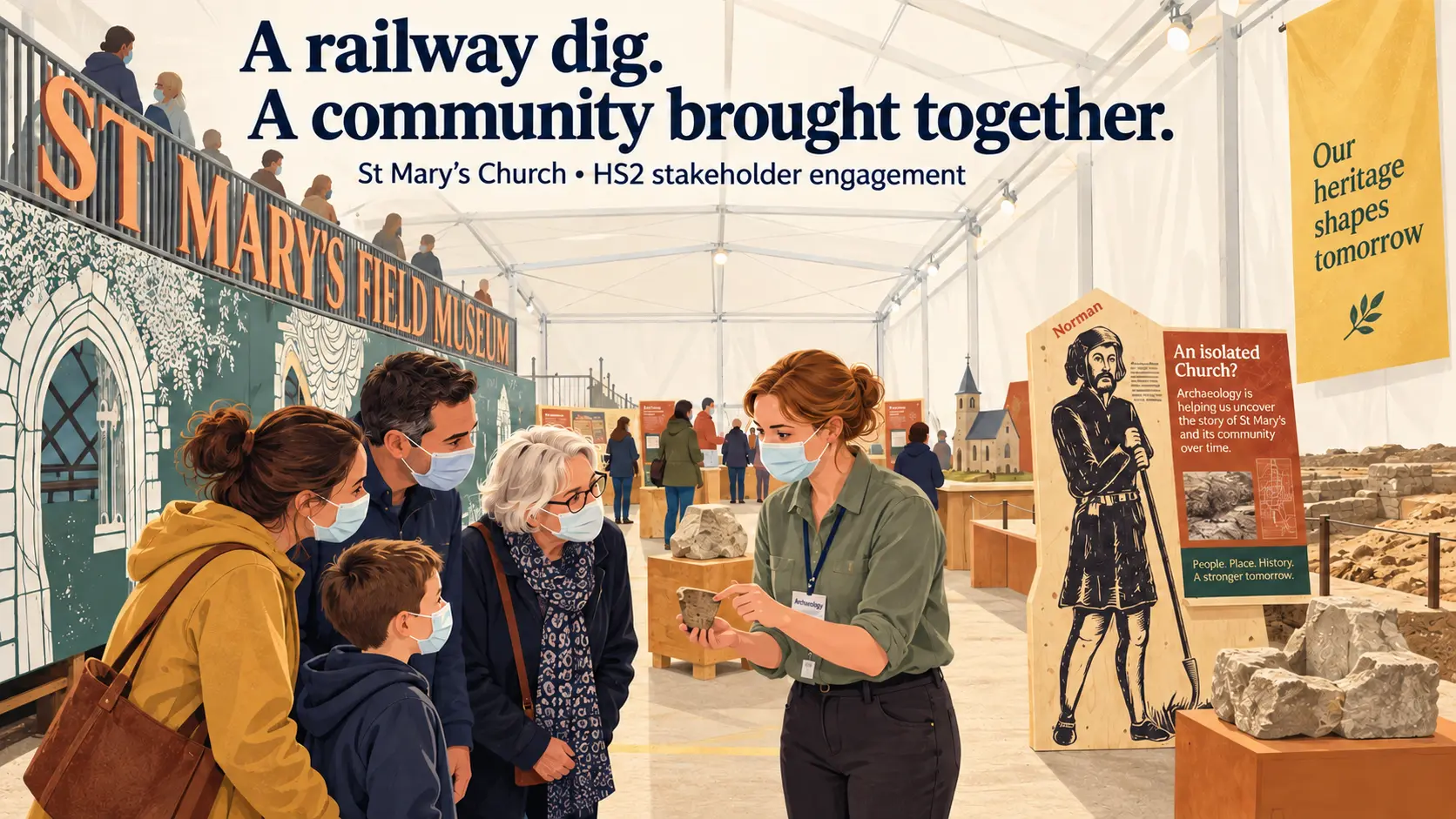
During excavations, the project team created the St Mary's Field Museum: a temporary visitor and learning space inside the working site. Residents could see discoveries, speak to archaeologists, share memories and learn practical skills. The main programme ran from May to September 2021, during COVID-19 restrictions.
This stakeholder management case study explores how the team handled a sensitive site and gave the community something of lasting value. It draws on Rachel Wood and Lily Hawker-Yates's account for HS2 Learning Legacy, the railway project's collection of published lessons and good practice.
Why was a railway project excavating a church?
The remains of the old St Mary's Church and its burial ground stood directly on the planned railway route. Archaeologists were investigating and recording the site before construction. The work formed part of HS2 Phase One, the London-to-Birmingham section of the railway.
The old church had been abandoned after a replacement opened nearer the village centre in the 1880s. Its dangerous ruins were demolished in 1966, decades before HS2. The railway works were therefore excavating the remains of a former church, rather than demolishing a church still in use. The burial ground's last recorded burial was in 1908. HS2's May 2021 account explains the site's history and excavation.
The work mattered to people beyond the construction team. Residents had memories of the place, and some visitors might have family connections to those buried there. How the team treated the site, and how openly it explained the work, mattered.
What did the team want to achieve?
The museum aimed to help people understand their local history, share their own knowledge and gain skills they could keep using. For the project team, it was a way to provide a public benefit while the work was happening and build better relationships with local people.
Fusion Joint Venture, the contractor carrying out preparation work for HS2, worked with specialist firm L-P: Archaeology to deliver the excavation and engagement programme. A smaller museum programme had run at the site in November 2018. The larger 2021 programme added seven open weekends, four heritage skills courses, films and activities for schools and young people.
The setting created a particular challenge. A large tent protected the excavation from the weather and screened the burial site from casual view. Some visitors wondered whether the tent was hiding something. A visit let them see the site, understand the arrangements and ask archaeologists their own questions.
For stakeholder engagement, that is a useful starting point: find out what people want to understand, then give them a meaningful way to explore it.
Who were the stakeholders?
The stakeholders included people affected by the work, those who could benefit from it and the teams responsible for making visits possible. This table maps the groups described in the source paper to their interests and involvement.
| Stakeholder group | Interest in the project | How they were involved |
|---|---|---|
| Local residents and people with family connections to the churchyard | Understanding the work, protecting dignity and keeping local memories alive. | Open weekends, conversations with archaeologists and a space to share memories. |
| Children, families, schools and young people | Accessible learning and opportunities to explore future careers. | Models, activities, school resources and online careers events. |
| Local heritage groups and course participants | Developing skills and contributing to local research. | Practical courses and visits for Buckinghamshire Archaeological Society, a local heritage organisation. |
| HS2, Fusion Joint Venture and the archaeology team | Delivering the work, explaining discoveries and providing public benefit. | Planning, designing, staffing and updating the museum and its events. |
| Health and safety and security teams | Protecting visitors and staff while controlling access to the working site. | Early involvement in routes, visitor numbers, checks and event arrangements. |
| Church authorities and the HS2 Burial Grounds Coordinator | Respectful treatment of burials and sensitive presentation of the excavation. | Requirements and discussions that informed screening and the use of images. |
A useful stakeholder analysis captures these different interests. A resident with a family connection to the churchyard needs a different conversation from a teenager exploring archaeology as a career.
How the team involved local people
1. Let people see the work and meet the experts
The museum sat inside the tent covering the excavation. A viewing platform allowed visitors to look across the site, while archaeologists explained what they were finding. Course participants could learn while the excavation was in progress, sometimes seeing a newly discovered object brought over by an archaeologist.
The team updated displays and films and added newly discovered objects as work progressed. Returning visitors could follow the discoveries. Engagement continued as the project changed.
2. Treat the place and its people with respect
No human remains were displayed in the museum or visible in the excavation during public visits. Visitors were told in advance, and again on arrival, that the outlines of excavated graves could be seen from the platform.
The team explained the study of human bones through a skeleton puzzle based on medical drawings. Children could explore the shapes and names of bones, while accompanying adults could decide how to approach questions about death.
One visitor's comment captured the value of that care:
“so much respect shown to the church and people”
3. Give visitors ways to contribute
The museum's “Your St Mary's” area invited people to share memories, thoughts and feelings. Their contributions became part of the exhibition. Local knowledge had a place alongside the archaeological findings.
Practical heritage courses also helped people develop skills they could use beyond the visit. These included recording historic graffiti, such as inscriptions and marks left on old buildings, and learning how specialists study human bones.
4. Make the experience accessible and interesting
The team offered several ways to understand the site: a model of the surrounding landscape, a Lego model of the church, a virtual view of the excavation, films and hands-on activities. Display text was written for a reading age of nine and assumed no previous knowledge of archaeology.
Ramps, room for wheelchairs and pushchairs, seating, accessible facilities and subtitled videos helped visitors take part. Films and school resources extended the programme beyond those able to attend.
The authors also identified improvements. Face masks made communication harder for some Deaf visitors and people with hearing loss. Large print material was available, but visitors had to ask for it. They recommended clear masks and placing large print versions beside the relevant displays.
5. Involve the teams who could make visits possible
Health and safety and security staff helped plan the programme early. Fenced routes separated visitors from restricted areas. The team prepared an event risk assessment, explained access rules before visits and managed bookings and cleaning during the pandemic.
For project managers, this is an important part of the story: successful public engagement depended on internal teams working together. The visitor experience had to be designed into the site arrangements.
What did the engagement achieve?
The source paper reports the following results for the 2021 programme.
1,560
visitors across seven open weekends
97
participants across four heritage skills courses
96%
of visitors said it inspired them to learn more about archaeology
The paper also reports that 88% of visitors said they had learnt something new. All heritage course participants said they had learnt something new during their course.
There were practical benefits beyond the events:
- Members of Buckinghamshire Archaeological Society were inspired to start a volunteer project recording church graffiti across the county.
- Two course participants signed up for further archaeology study, one for a degree and one for a diploma.
- Two museum visitors went on to gain work experience in commercial archaeology.
- Some residents returned several times, and visitors asked for similar events at other construction sites.
The clearest success was what people did next. A temporary museum helped prompt further learning and a new volunteer project. That gives project managers a more useful measure of engagement than attendance alone.
Evidence note: these findings come from the project team's published account and visitor feedback. The paper does not give the response count for the 96% and 88% figures. They show a positive response to this programme; they do not measure a change in support for HS2 across the wider population.
Lessons for stakeholder management
The choices made at St Mary's offer five lessons for teams working with communities:
- Start with what people care about. Local history gave residents a reason to engage. Find the connection between your work and stakeholders' own interests.
- Make questions easy to ask. Direct access to the people doing the work can help people understand decisions and test their assumptions.
- Offer a useful role. Sharing memories and learning recording skills gave participants something to contribute and take away.
- Design for different needs. Plan access, language, activities and sensitive subjects around the people you want to involve.
- Measure what people gain. Attendance shows reach. Learning, further study and community activity tell you more about the benefit.
At St Mary's, stakeholder management became part of how the work was carried out. Archaeologists made time for questions, the museum made room for local memories, and courses gave people skills to use elsewhere. Those are practical choices other teams can copy.
Apply the lessons to your project
Choose an activity that connects your project with something people care about. For a construction project, this might be a guided visit explaining changes to a familiar place. For a software project, it could be a workshop where users try a working version and influence the next changes.
Questions for your engagement plan
- What do stakeholders want to understand, protect or learn?
- What can we show them, and who can answer their questions?
- How can their knowledge or experience contribute?
- Who needs to help us plan access, safety and sensitive discussions?
- How will people who cannot attend still take part?
- What benefit should remain after the activity ends, and how will we check?
Use these questions alongside our stakeholder engagement approaches to choose activities that fit your project and its stakeholders.
Sources and further reading
Wood, Rachel (AECOM/Fusion-JV) and Hawker-Yates, Lily (L-P: Archaeology), 4 March 2023. St Mary's Church: demonstrating the limitless possibilities and value of on-site archaeological public engagement in construction projects. HS2 Learning Legacy.
HS2 Ltd, 5 May 2021. HS2 archaeologists uncover nine centuries of local history in Buckinghamshire. Background on the former church and why the site was excavated.
HS2 Ltd. About Britain's new high-speed railway. Background on the railway's route and purpose. Accessed 13 September 2026.
The Learning Legacy paper describes the museum design, activities, safety arrangements, visitor feedback and lessons learned. The stakeholder analysis and advice for applying the case to other projects on this page are StakeholderMap.com's interpretation.